
Structure: The Scaffolding of TTRPG Design


Recently, a friend asked if he could pick my brain about structuring book-length tabletop roleplaying game adventure content. I said, "yes, of course," but afterwards I began to think. A lot of what I do, I do internally. It's not so much "going with my gut" (a term that has, for me, an uglier association than it used to) so much as having learned and done a thing for so long that a lot of what was deliberate is now rote behavior.
I come from a background in film and, after film, from book publishing, and after that from novel writing. Way at the start of that there was some playwriting, but nothing I hope anybody ever sees again! My earliest experiences with structure came from learning to write screenplays.
A sort of holy grail for me right now is to nail down a pattern for how what I know about scriptwriting can apply to TTRPG design. Some of it does. And some of it is wildly inappropriate. I've been chasing that grail for a while, but I think chasing it is a mistake. I should stop thinking about how to take scriptwriting and force the square peg into the round hole of TTRPGs. Instead, I need to work my way backwards from TTRPGs and see where the common ground might lie.
One of the ways I taught myself to understand film was to rigorously outline it. I would sit with a laptop on the couch and a remote beside me, and I would write down every single beat in a movie, being careful to note the timestamp periodically. Seeing what occurred when, and at what percentage of the total runtime, taught me a phenomenal amount about pacing.
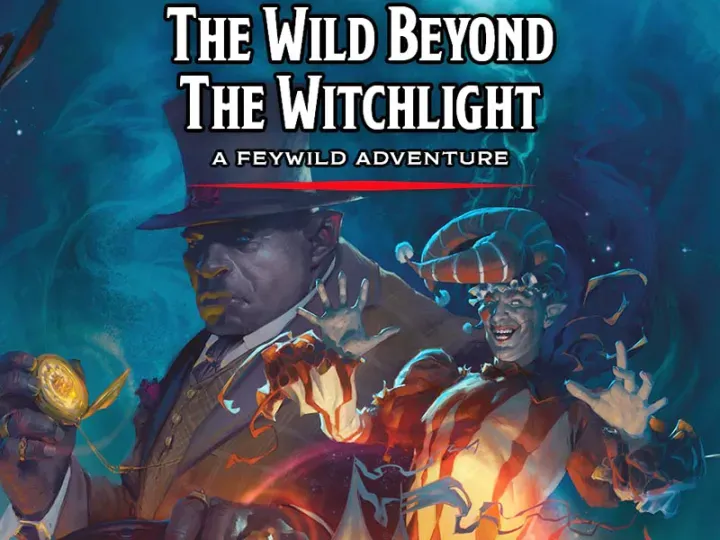
Taking my own methodology as advice, let's look at one of my favorite hardcover TTRPG adventures in recent years, The Wild Beyond the Witchlight, published by Wizards of the Coast and written by Stacey Allan, Will Doyle, Ari Levitch, and Christopher Perkins.
There will be only minor spoilers. But there will be minor ones.
In the adventure, a world-hopping fairy circus provides the gateway into a fractured-fae realm, culminating in a trip to magical palace where the reason for the realm's aforementioned fracturing is uncovered and perhaps resolved. The Wild Beyond the Witchlight employs a five-part structure. It's comprised of an introduction, three exploration regions, and a conclusion.
The Witchlight Carnival is our introduction. It's a mostly harmless visit to a magical circus where clues to a larger world and a problem that needs solving are seeded. But hidden in the carnival is a portal into our aforementioned fae realm.
Then we get the three realms of Hither, Thither, and Yon, each ruled by a hag. These are mostly open sandbox worlds, with a variety of encounter situations scattered around a not-to-scale (because what is in the fae realm?) map. There's not definite "solution" to each of these realms. The hags can be fought or bargained with or maybe even avoided. It's not necessary to hit all of the encounters. But each realm has several connections to the next one.
Finally, after traversing all three realms, we find our way to the Palace of Heart's Desire, where our characters may end up setting the world to right, most likely after a climactic battle.
So we have:
Introduction>Open Sandbox>multiple paths to>Open Sandbox>multiple paths to>Open Sandbox>Conclusion.
It's a really neat structure, stringing these three sandboxes between a couple bottlenecks and framing it with an introduction and a conclusion.
Do you know what else has that structure?
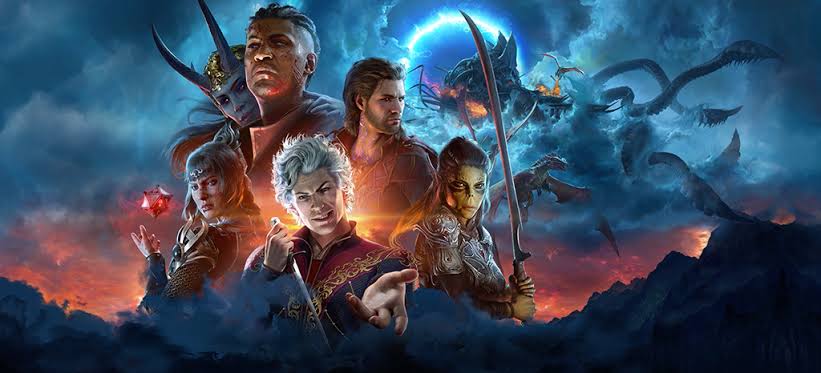
Here, the introduction is split between the opening cinematic and the time on the Nautilus ship. Then we get 1: The Wilderness & Underdark, 2: The Shadow-Cursed Lands, and 3: The City of Baldur's Gate. And finally the conclusion.
Again, these open sandboxes are connected by bottlenecks that offer more than one path between them. And each region has more in it than you can ever explore and it's not necessary to hit everything (even if that's fun!). There's choice and agency in the sandboxes, but each connective tissue funnels you into the next one, and the frame of Introduction and Conclusion grants the sense of "story."
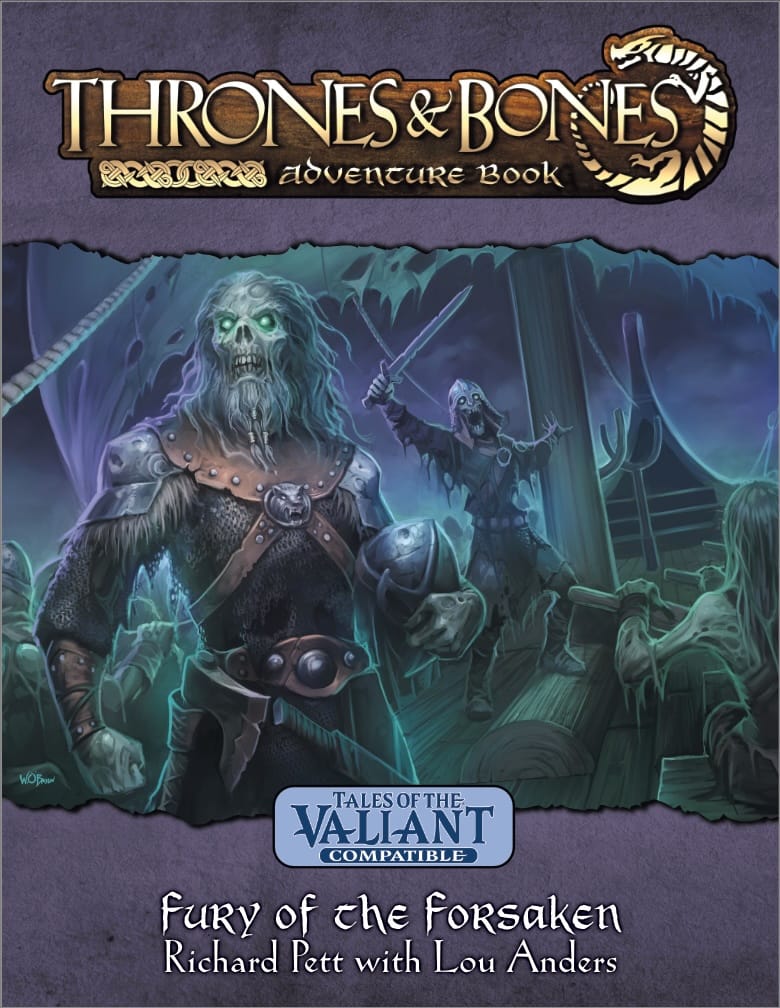
The wonderful Richard Pett and I employed a similar structure in our co-written adventure Fury of the Forsaken. Again with spoilers: In the adventure, anticipating a brutal winter, the Jarl of the city of Bense sends the characters to deliver a couple aurochs (cows) to help a small village weather the harsh season to come. Arriving there, they find the village deserted, having fled to a lake-town known as Frekrheim. Arriving at Frekrheim, the winter hits early, trapping the townsfolk in, whereupon a draugr with an undead army rises from the sea and threatens to return in three days and destroy the town. The characters have to play at Seven Samurai, reinforcing the town and teaching the townsfolk how to defend themselves, but each night a visit to the dream world reveals clues about the town's dark history and the undead's grievance. Finally, it all ends in a battle where certain secrets may come to light.
So we Introduction (village) > three days of training that is mostly up to the character's choices (Sandbox) but the Bottleneck of each night's visit to the dream realm before they are ushered into the next day > Conclusion.
So there you have it: Three examples of a structure that provides the scaffolding upon which to hang three very different adventures. None of these adventures resemble each other in terms of story elements, theme, encounters, or plot. But they share a very robust skeleton. If you start with a strong skeleton, you can build anything on it, and it will stand.
Let me know what other TTRPG structures you've encountered. Which you like and which you don't. And whether you'd like to see more of these kinds of posts.
And, if you would be so kind, consider Signing Up to Be Notified about the next Lazy Wolf Studios project, the three-volume project known as Lands of Katernia, featuring a monster book, an adventure book, and a setting guide, coming to Kickstarter.