Structure: Two World-Hopping Campaigns


Recently, I wrote a post about TTRPG design called "Structure: The Saffolding of TTRPG Design" in which I looked at the shape of The Wild Beyond the Witchlight, Baldur's Gate 3, and Fury of the Forsaken.
As a follow up to that piece, I want to examine two adventures that I really loved running which I believe share a few points of commonalities. The adventures are Storm King's Thunder from Wizards of the Coast and Empire of the Ghouls from Kobold Press. Both adventures are globe-trotting campaigns that showcase large areas of the Forgotten Realms or the world of Midgard, giving their players and GMs a broad overview of their respective lands. To play through either is to come out with a very grounded understanding of their respective settings.
I played Storm King's Thunder in 2019 and 2020. It was a lot of fun and the first time I really put a lot of terrain on a table. Unfortunately, we only got halfway before the pandemic struck, and by the time people were gathering in person again, my group had dissolved. Two folks had moved away and one had even finished the adventure with another group. Sadly, that means we never finished. But the pandemic did drive me to learn to play online, where I found another great group (who I am still playing with today) and we ran Empire of the Ghouls. And this we did finish.
Now, be warned, there will be some MILD SPOILERS as we look at these two campaigns.
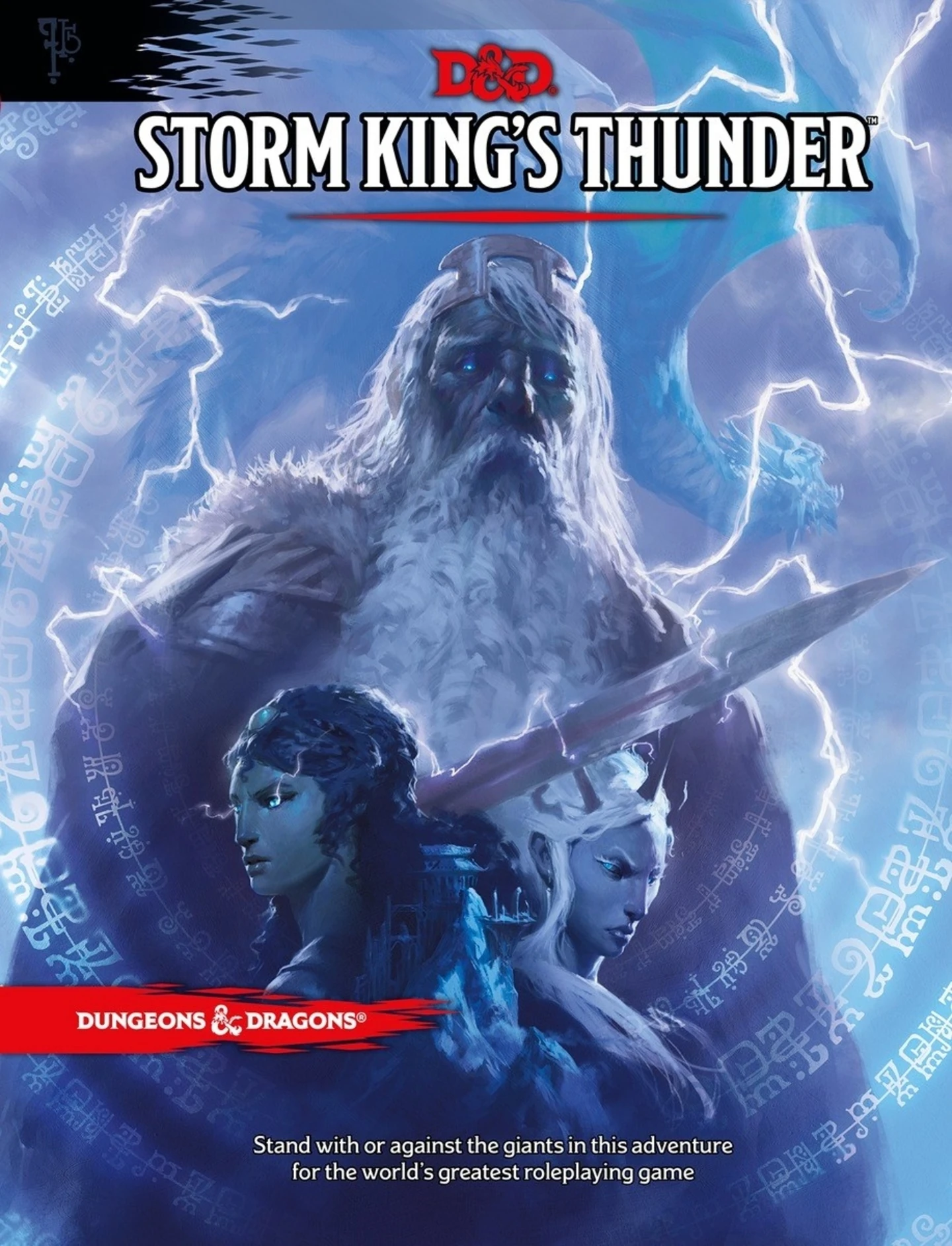
Storm King's Thunder, from lead designer Christopher Perkins, sees adventurers journeying all over the Sword Coast in an effort to discover why every category of giant is causing continent-wide havoc. The reason is that giants all fall into a hierarchy called The Ordning, and the head of the Ordning has gone missing. Now giant lords everywhere are all reacting to this development, most seeking ways to become the new head or prove to their god that they should be chosen to fill the vacant shoes. One of the interesting things about this adventure, or frustrating aspects depending on your perspective, is that reinstating the head giant isn't necessarily the solution. Wizards published several adventures around this time that leaves solutions "open ended" so GMs can come up with their own. I personally prefer an answer, or, if the adventure doesn't want to give me a single answer, a multiple choice. But leaving that aside, let's look at the structure.
Storm King's Thunder has a kind of tree structure in which certain sections open up with multiple paths and then everything comes back through a funnel to the next section. It's not a "ticking clock" adventure, so both a strength and a weakness of it is that you can wander for pretty much as long as you want to before the GM decides its time to reign things in and bring on the next section.
It opens with an introductory giant attack on the city of Nightstone, but the adventure also says you can substitute any other adventure or adventures that takes character from first to fifth level. (For my group, we ran Lost Mines of Phandelver and then went into Chapter 2).
Regardless of your start, it should end with a cloud giant named Zephyros showing up in his flying tower and telling the characters that his divinations have revealed they are important to, essentially, the plot, and he's here to ferry them to their next location.
Here, the adventure gives the characters a choice of heading to Bryn Shander, Goldenfields, or Triboar. Regardless of where they end up, the characters will get there in time to help defend the town against an attack of giants, either ice, hill, or fire depending. In each town, there are a handful of "special" NPCs the characters are tasked with keeping alive. Each one that survives has a quest for them, though it's usually something trivial, like carrying a message or making a delivery.
Following these quests leads us into Chapter 3, "The Savage Frontier". This is what I think of as the "Skyrim portion of the game", as your PCs find themselves trekking all over the Sword Coast, during which they may or may not encounter more evidence of giant shenanigans. The chapter contains a large section detailing Sword Coast locations. Among other things, it's a really good overview, almost a gazetteer, of this land. If your table likes exploration and travel, this is a really fun section, even as it's one that brings any sense of urgency to a halt. If I sound critical, let me say that my table had a blast here, with many fun adventures, including ridding a hunting lodge of wights. We spent a lot of time in this chapter, and in fact, they were building a castle at the hunting lodge when the pandemic hit.
Eventually, when the GM decides its time, you drop in an encounter with Harshnag the friendly frost giant. The adventure text literally reads, "After romping around the North for a while, the characters might reach a point where they can’t decide where to go next. That’s the best time to use this encounter." Harshnag has found the players and wants them to meet him at a legendary temple called Eye of the All-Father, where they need to consult with the oracle there. In other words, we've had enough rambling fun, it's time to get back to the plot, so let's just drop it square on our characters' heads.I'm not a fan of this device, which feels like the designer's hand ripping through the game like one of Terry Gilliam's animated Monty Python sequences to pick us up and drop us where we need to be.
At any rate, at this point the oracle sends the players on a quest to prove themselves, which is itself a bit of a mini-sandbox in that they can choose which of several sites to visit, and they can choose to visit more than one. Different paths will open up from here depending on which quests they complete.
This leads to the next five chapters of the book, each of which details the lair of one of five giant lords. The characters need only face down one, before proceeding on to the conclusion of the story. They then go to the storm giant palace of Maelstrom, where they receive a clue to the titular Storm King's location. Presumably freeing him next, they then ally with the storm giants to take down the evil blue dragon who was the secret Big Bad of the adventure. (She's not an active villain so you don't encounter her until late in the game.)
Plot-wise, it's not great. Adventure-wise, it's a hell of a lot of fun trekking all over the Sword Coast and fighting every kind of giant imaginable. And each of the giant lairs is really a whole mini adventure in its own right.
Structure-wise, it's really interesting:
- Choose the official introduction or enter from another adventure
- A funnel to
- One of three locations which then somewhat determine
- Where you go in a very, very large open sandbox until
- Another funnel scoops you up and sends you into
- A small sandbox in one region which then determines
- Which (and how many) of five different locations you can choose to visit, each of which leads you to
- The conclusion of the adventure's mystery, followed by
- A fight against a newly-revealed enemy.
Choose your intro > funnel > choice of 3 > open sandbox > funnel > mini sandbox > choice of 5 > conclusion + epilogue
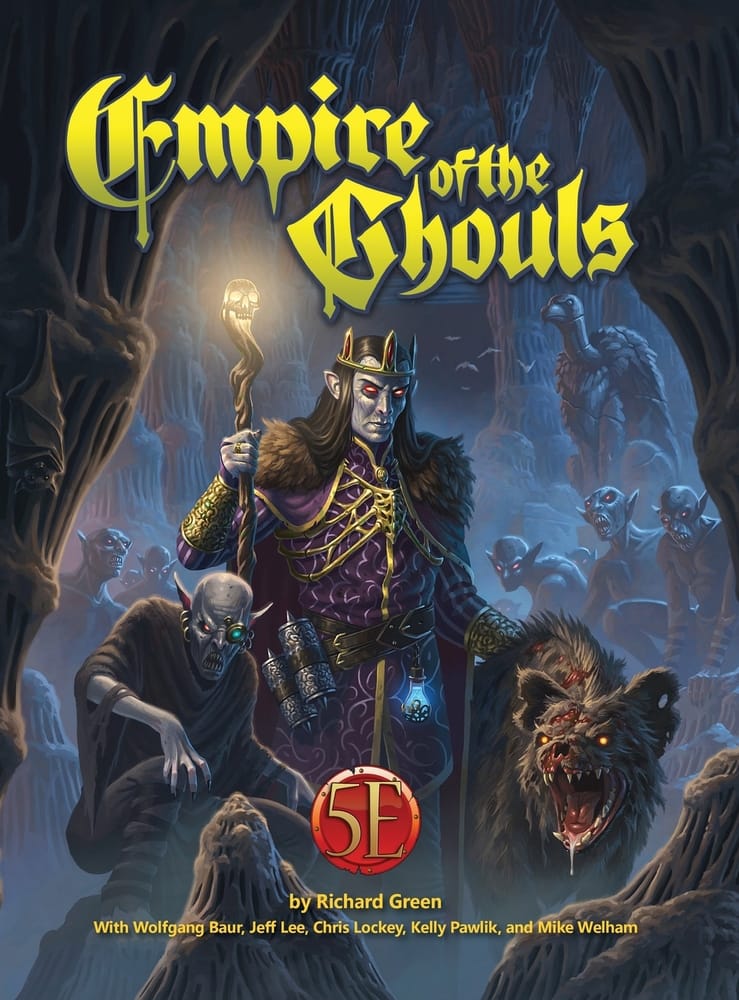
Empire of the Ghouls, from lead designer Richard Green, is likewise a globe-trotting campaign with high stakes. It's set in the world of Midgard and deals with attempts to strengthen the alliance between the above-ground Vampire Kingdom and the below-ground Ghoul Empire. The book opens with a 41 page gazetteer that covers way, way more than the adventure needs, so GMs have enough to keep playing in this sandbox however they want. The adventure itself concerns a ghoul duke and a vampire high priest who are plotting to grow ghoul power. The former thinks that if he does so, he may be able to challenge the emperor for the throne, while the latter is hoping to create a dark theocracy. I'm not sure my players ever understood the intricacies of the politics, but they got that ghouls and vampires playing together extra nice was bad and needed to be stopped.
The adventure plays out in six parts. You start out in Kobold Press's city of Zoebeck, where the kobold community is being scapegoated to allow cultists cover in which to develop their schemes. This introductory adventure sees you going around and below the city and facing down a cult, but it doesn't connect too deeply to what follows. At the end of it, an oracle at a temple contacts the players and tells them that they have a part to play in, essentially, the plot. The oracle then sends them on a quest to find a holy relic, "the Holy Robes of Sister Adelind." (I dig that the adventure in specific and Midgard in general has a lot of the religious tropes and trappings of actual middle ages Europe in its setting. The Forgotten Realms always seems to me to be a pretty tonally agnostic place despite all its pantheons.)
This quest for the robes leads to a chapter of the same name. Here, the characters are sent first to some dwarvish cantons to look into clues about the relics whereabouts, but along the way they find out about a ghoul plot to kidnap Archduke Avgost, a noble who is in exile after his nation fell to the vampires. You meet the court in exile, including the monarch, and are tasked with safely escorting the duke through vampire territory to a city called Jozht, where Reaver Dwarves (ie vikings) have established a beachhead in vampire territory. In Jozht, you learn about the Spear Maidens who keep the relic, but when you journey to meet them, you discover several of their number and the relic itself have been captured and taken to a castle, whereupon you mount a rescue. Then it's back to Jozht, where a vision from another goddess reveals that the characters have a part to play in things to come and need to hang onto the Holy Robes.
This leads to the next chapter, where the goddess' vision sends the players across the seas to a Reaver's Cave, where they find the remains of a huldra (a fearsome female trollkin warrior) with a plea that her remains be returned to the Huldramose. That leads (eventually) to a wild night of partying and proving yourself to the queens of the Huldra, followed by a quest to stop a vampire and ghoul wedding that serves as avatars of their respective gods coming together. My players had a ball with this. We nearly had a TPK at the wedding, but it was one of the most epic fights of our gaming lives.
After the ending, you learn the Duke Avgost has gone and got himself kidnapped anyway once he was outside the characters protection. I'm not crazy about this, as it seems to invalidate everything the characters went through to escort him safely in our earlier chapters. Regardless, to rescue him, you're told not to head straight after the kidnappers, but instead to counterintuitively journey to the Southlands where some folks there have magics that will allow living beings to visit the ghoul kingdom without immediately looking like so much fresh, free meat.
This entails a trip to deserts and a necropolis, fighting mummies and things.
And then it's a trip into the vast underground where the ghoul kingdom is.
The adventure concludes in an epic battle in the Pure City of Vandekhul, where, no matter when the players arrive, it's just in the nick of time to save the duke from being sacrificed.
Despite my quibbles about how the plot advances, the individual set pieces are top notch and the story is epic. It really is an amazing (if very dark) adventure.
Looking at the two adventures, they are both excellent travel-based campaigns that masterfully accomplish the heavy lifting of teaching both characters and GMs a lot about their respective worlds. Both are full of exciting encounters in diverse locations, and both contain their fair share of epic moments. Where they differ is that Storm King's Thunder includes several branching points and limited or bounded sandboxes before funneling characters back to the main narrative, whereas Empire of the Ghouls is a very linear adventure that sends its characters through specific points with no variation or sandbox elements.
Where I fault them both is that they each rely on outside forces, mostly divination and prophecy, to swoop in and jumpstart each new section of the adventure, rather than on layering clues for the characters to pick up on that suggest their next destination. In globe-trotting campaigns, I can see the necessity of making sure parties trot the globe correctly, but I maintain that a set series of clues, to be uncovered irrespective of location, could accomplish the same thing. Both adventures are fairly old now. Storm King's Thunder was published in 2016 and Empire of the Ghouls in 2020. It would be interesting to see a new globe-trotting campaign from either Wizards or Kobold Press to see how it would be handled now.
I do recommend both of these books, and, as always, it's important to remember that plot is often the least important aspect of creating fun at your table. The plot is the excuse for your players to do epic things and have amazing moments. There are certainly plenty of those to be had in both these books.
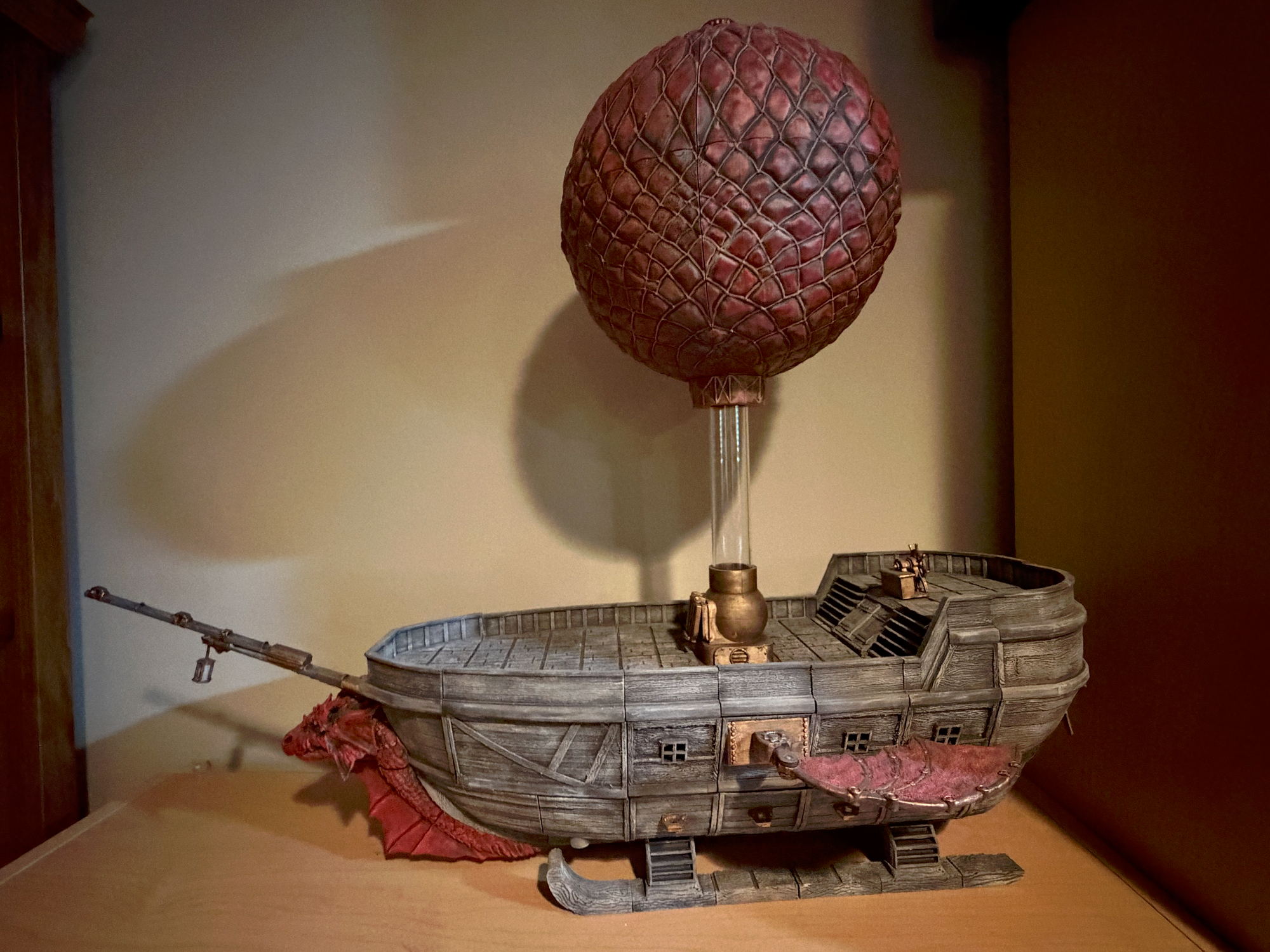
I'll leave you with that thought, and the amazing sky ship I 3D printed during the pandemic for the campaign that never returned to use it...